— SYMBOLA CHAOTICA —
The Chaos Star: meaning, origin and practical use
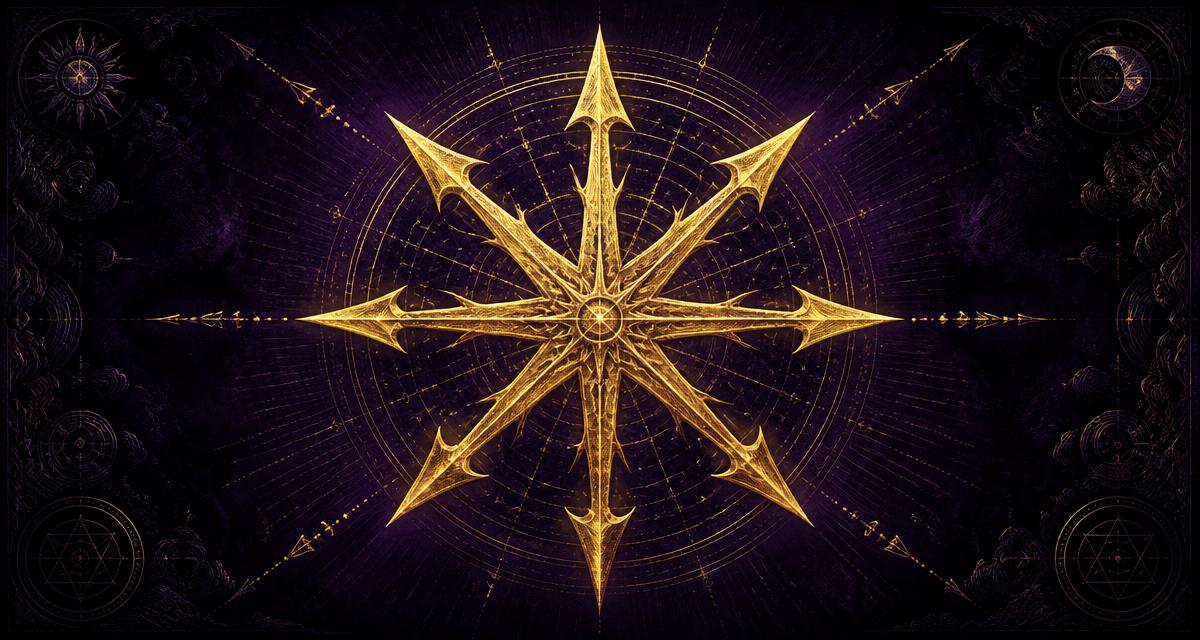
Eight arrows moving away from a shared centre. It's the most recognisable emblem of chaos magick, and its geometry already holds the whole theory: no direction is mandatory.
The bigger picture lives in the full guide to chaos magick.
What the chaos star is
The chaos star (also called the symbol of Chaos) is made of eight arrows radiating outward from a single centre at 45-degree intervals. It's not a sigil with a name to evoke, nor the crest of a deity: it's a conceptual diagram. It says one thing, and says it well: from wherever you stand, many paths lead outward, all walkable, and none has the right to call itself "the" path.
That's why chaos magick adopted it as its signature. A system that rejects orthodoxy couldn't pick the symbol of a tradition; it needed the image of a method instead.
Origin: from Moorcock to practice
The symbol doesn't come from an old grimoire. It comes from the fantasy fiction of Michael Moorcock in the sixties, in the Elric of Melniboné saga: in his cosmos, Law is shown as a single vertical arrow — one order, one direction — while Chaos shows eight, the totality of possibilities. It's not good versus evil: it's multiplicity versus rigidity.
In the seventies the symbol was picked up by the British magical circles who were formalising chaos magick around Peter J. Carroll and Ray Sherwin, and later by the order of the Illuminates of Thanateros. A coherent choice given the theory: if beliefs are interchangeable tools, then a symbol born of pop fiction is legitimate magical material too. This move — treating a fictional icon as an operative tool — is itself a lesson in paradigm shifting.
From there the star spread well beyond magical circles: role-playing games, music, tattoos, video games. It often circulates without people knowing its history, and this independent life of the symbol is the most elegant proof of how an image gathers power through use and repetition.
The eight rays, one by one
There's no canonical attribution for the eight arrows: anyone claiming otherwise is selling dogma. But there are useful operative readings. This is the one we use as a working grid.
Each arrow marks a way out of the centre: no path is privileged.
Eight rays instead of one: many valid descriptions of the same reality.
The regular layout denies any hierarchy among paradigms.
The point of origin is the operator: that's where intent starts.
The tips point outward: the symbol describes a movement, not a state.
What leaves the centre can return to it: every construct can be dissolved.
Not a god to worship, but a technique to remember.
Eight possibilities mean eight choices, and every choice has a cost.
How to use the chaos star in practice
A symbol hanging on a wall does nothing. Here are four concrete uses, each linked to a tool on the site you can try right now.
Frame for sigils
Draw the star and place the glyph at the centre: the eight arrows act as a diffusion field for the intent at the moment of charging.
Generate a sigil →Fixation point in gnosis
Staring at the centre of the star with slow breathing is one of the simplest inhibitory ways to quiet inner dialogue.
Gnosis Chamber →Map of the eight paradigms
Assign a symbolic system to each ray (runic, goetic, shamanic, pop, planetary…) and let the draw pick the one for the operation.
Consult the Oracle →Theoretical reminder
The star sums up the principle "nothing is true, everything is permitted" in one image: handy as a signature on your diary or altar.
Read the principles →Practical rule: draw the star by hand before each work cycle, and note in your diary which ray — which paradigm — you used. After ten operations you'll have your own data, not someone else's opinions.
How to draw it
- 01.Draw a vertical-horizontal cross with a clearly marked centre.
- 02.Overlay a diagonal cross, giving you eight rays at 45 degrees.
- 03.Add an outward-facing arrowhead to each ray.
- 04.Check the symmetry: no arrow should end up longer than the others.
Frequently asked questions
What does the chaos star mean?
Eight arrows radiating from a single centre: the infinite directions of the possible and the absence of a mandatory direction. It's the symbol of paradigm freedom.
Who invented it?
Michael Moorcock, in his fantasy novels of the sixties: eight arrows for Chaos against the single arrow of Law. From the seventies the symbol passed into British chaos magick and the Illuminates of Thanateros.
Is it a satanic symbol?
No. It belongs to no cult and carries no doctrinal content: it points to a method, not a faith.
Eight points or five?
Eight. Variants with more or fewer rays belong to other symbolisms (planetary stars, compass roses) and aren't the chaos star.
Can I draw it myself?
Yes, and it's recommended: draw a cross, overlay a Saint Andrew's cross, then add the arrowheads. A hand-drawn symbol is more effective than a printed one.
From symbol to practice
The star points in eight directions: it's up to you to walk one. The site's free tools are enough for your first complete operation; joining the Circle unlocks rituals, tutorials, the grimoire and the community.